Shirley, Goodness and Mercy

“Shirley, Goodness and Mercy” by Chris van Wyk is the fascinating childhood memoir of life in a Coloured township during the apartheid days in South Africa. It is well written and humorous. I can definitely recommend it particularly to all South Africans.

“One afternoon Greg comes home from school crying….

‘What’s the matter? asks his sister Kathy.
‘Arlene hit me.’
Arlene is Kathy’s age and they attend the same school. But that counts for nothing, it seems, when family honour is at stake. Kathy dons her fighting garb of shorts and T-shirt and prepares to stick up for her younger brother. She grabs Greg’s hand and storms off up the road to where Arlene stays. Kathy walks right in and delivers a couple of slaps to Arlene’s face and warns her to ‘Leave my brother alone!’

That evening Arlene’s dad comes to complain at the Van Wyks.
‘Is this true, Kathy?’ her father asks her.

That evening Kathy’s dad makes his daughter and son move a few dozen bricks from one place in the yard to another. This is punishment for slapping Arlene.

Greg sniffles and complains about what he sees as an injustice but Kathy says, ‘Don’t worry, they don’t realize that carrying bricks around just makes us stronger.’

Moral of the story : It’s all about perceptions, whether we see the glass as half-full or half-empty.

Do you identify with Greg sniffling and complaining how life is so unfair? Or can you see the situation from another perspective like Kathy? Carrying bricks, or facing up to difficulties can in the end make you stronger. All depends on attitude.


The down-side of being brilliant!

Have you ever thought
“if only…. I were thinner….then..
if only… I was richer…
if only … I was cleverer”?

We can waste our energy in this type of unproductive thinking but …

This past week I decided to read the book “A Short History of Nearly Everything” by Bill Bryson. My husband had bought the book so we had it at home. To be honest I wouldn’t have bought the book as it sounded too ‘intellectual’ for me, but seeing as we had it and I was hoping to get a bit cleverer, I started reading.

I’m a third of the way through, and am utterly amazed at how brilliant some people are, easily comprehending concepts like atoms, relativity and the universe. I think I’ll have to settle with accepting my limited intellect, but what I did enjoy were some of the personal stories of these scientists, and I want to share one of these with you.

Henry Cavendish (10 Oct 1731 – 24 Feb 1810)

Henry Cavendish was the son of Lord Cavendish and was born into a life of privilege. He attended Cambridge University from 1749 to 1753, but left without obtaining a degree. However he was one of the most gifted scientists of  his age, but also one of the strangest. He was the first to recognize hydrogen gas as a distinct substance. He also described the composition of water and made the first accurate measurement of the density of the Earth.

Now, that in my opinion, makes him intellectually brilliant!

However, he had his problems.
He suffered from shyness to a ‘degree bordering on disease’. Any human contact was for him a source of the deepest discomfort. Once he opened his door to find an Austrian admirer, freshly arrived from Vienna, on the front step. Excitedly, the Austrian began to babble out praise. For a few moments Cavendish received the compliments as if they were blows given from a blunt object and then, unable to take any more, fled down the path and out the gate, leaving the front door wide open. It was some hours before he could be coaxed back to the property. Even his housekeeper communicated with him by letter.” (Bill Bryson: A Short History of Nearly Everything, p85).

His female domestics had orders to keep out of sight, on pain of dismissal. His dinner he ordered daily by a note placed on the hall table.” (http://www.blupete.com/Literature/Biographies/Science/Cavendish.htm)

Lesson to be learnt

  • Stop looking at others with envy. We may see the brilliance of others, but seldom do we see their weaknesses. Start seeing the brilliance in yourself (even if it’s not academic!)
  • Stop saying “if only .. then…” Live your life in the ‘here and now’ because this is the reality you have. Only when you accept reality can you make a plan to change aspects you don’t like. A childhood refrain just popped into my mind – “Jealousy gets you nowhere!” – brains aren’t everything!

Click here to see the book “A Short History of Nearly Everything” on Amazon.


‘Attitude’ – Charles Swindoll

“The longer I live, the more I realize the impact of attitude on life.
Attitude, to me, is more important than facts.
It is more important than the past, than station, than money,
Than circumstances, than failures, than success,
than what other people think or say or do.
It is more important than appearance, giftedness or skill.
It will make or break a company … a church … a home.

The remarkable thing is, we have a choice every day
regarding the attitude we will embrace for that day.
We cannot change our past … we cannot change the fact
that people will act in a certain way.
We cannot change the inevitable.
The only thing we can do
is play on the one string we have,
and that is our attitude …

I am convinced that life is 10% what happens to me and 90% how I react to it.
And so it is with you …” – Charles Swindoll


Mad as Hell!!

How do you react when someone makes you angry? Do you come out ‘guns-a-blazin’ ready to annihilate the other person?
Or do you sulk and and give the cold shoulder.
Neither of these ways will result in a successful outcome. Read on …

South African Taxi-drivers
I live in South Africa and our taxi-drivers make me really mad! I’m not talking about your regular cab-driver but mini-bus taxi drivers. Mini-bus taxis are the main transport for thousands of South Africans. They drive dangerously and are a law unto themselves. Driving through red traffic lights and overtaking on solid white lines are minor transgressions. Most road deaths here are from accidents involving these mini-bus taxis.

A time when I was as Mad as Hell!
I was fetching my daughter from school when I was caught in a minor traffic jam. A bit of patience and we’d get through without huge delays. I was chilling out when I looked in my rear-view mirror and saw the taxi behind me starting to overtake me on a solid white line and on a blind corner. I was furious! No ways was I going to let him in and I quickly closed the gap between me and the car in front.

I soon changed my mind! My blood pressure was rising and I realised that I wouldn’t win. Taxi-drivers here don’t mind dents in their vehicles, but I do. I could see he was trying to push me off the road. I gave up and let him in but was still very angry!

Thinking further down the line!
I then thought that my determination not to let him in, could possibly contribute to a terrible accident. What if he collided head-on with an innocent motorist  coming round the corner. That sort of accident could be averted if I just let him in. So even though I had a right to be angry, and felt justified not letting him in, I had to think a bit further down the road about the possible consequences of my behavior? (I wish he had done the same.)

Although innocent I had to take responsibility for how my angry reaction could aggravate the situation.

THREE WAYS TO RESPOND TO ANGER!

  • The ‘Mad’ route
  • The ‘Sad’ route
  • The ‘Glad’ route. Why ‘Glad’? Well, ‘glad’ rhymes with mad and sad and so is easy to remember! We need to aim for the ‘Glad route’ where everyone ends up happy.

The Mad Route
When someone criticizes you do you attack them back?  Many people justify their angry outbursts by saying ‘that’s the way I am – I blow up and then it’s all over’. However, that sounds like a shotgun firing, and what about the damage that’s left behind? The implication of this kind of remark is that you’re not responsible for your behavior.

If you get mad when someone criticizes you the implication is that you’re perfect and don’t make mistakes. ‘How dare so-and-so criticize me, the perfect one!’ By the way an anger response is very common to a perfectionist..

Getting ‘mad’ badly affects your joy and health. Excessive anger leads to raised blood pressure and a possible heart attack as well. It causes anxiety for those around you. We can conclude that a knee-jerk ‘mad’ response is a BAD IDEA!

The Sad route
When someone is angry with you do you have a ‘pity-party’? Poor me! Or maybe you withdraw, give the cold shoulder, or the silent treatment for a few days. The problem with this type of response is that it is very manipulative. Getting mad is an active anger response, withdrawing is a passive anger response. It is not loving and actually quite self-centred.

Bottling up your anger can lead to bitterness and poisons the system. You can bet your bottom dollar it will find release somewhere, even after a very long time. I have heard people spew out long built up resentment and it’s not pleasant. A bit like an old-fashioned pressure cooker which leaves a mess everywhere when it explodes.

The Glad response
To get the best result when someone is angry with you need to watch your tongue. Count to 10 before your respond. Think before you speak. Ask yourself if it is really worth loosing your cool over the issue.

I think we can learn a valuable lesson from Abraham Lincoln. When he had to write a letter to someone who had irritated him, he would often write two letters. The first letter was deliberately insulting (giving full vent to his anger). Then, having got those feelings out of his system, he would tear it up and write a second letter, this one tactful and discreet.

3 STEPS TO EFFECTIVELY DEAL WITH ANGER 

Step 1. If someone is angry with you RULE ONE is do not defend yourself. Yes, you read right – DO NOT DEFEND YOURSELF! We have two ears and one mouth so we need to listen twice as much as we speak! Listen to what the other person has to say.

A person who immediately becomes defensive usually responds this way because of a poor self-esteem. Do not defend yourself and remind yourself that the angry person is entitled to his opinion and that is all it is, his opinion.

Step 2. Listen for a grain of truth in what the other person is saying and acknowledge it to the other person. At this point it is not about you but about making the other person feel heard and loved. Find out more. Even if you feel there is no truth you can still be loving. Thank the person for sharing their feelings. Listen because the person can be right or wrong, or somewhere in between. How are you going to know if you don’t listen! None of us are perfect (that’s a fact!) and maybe we can learn something from the other person’s criticisms.

Step 3. Clear up any misunderstanding. Respect the other person for having the guts to share their feelings with you. Speak the truth in love

The Book of Psalms in The Old Testament is full of wisdom about anger. Here’s a selection of wise sayings.

Don’t make friends with people who have hot, violent tempers. You might learn their habits and not be able to change. Proverbs 22: 24-25

People with quick tempers cause a lot of quarreling and trouble. Proverbs: 29:22

Whoever is slow to anger has great understanding, but he who has a hasty temper exalts folly. Proverbs 14:29

Hot tempers cause arguments, but patience brings peace. Proverbs 15:18

People with a hot temper do foolish things; wiser people remain calm. Proverbs 14:17

A soft answer turns away wrath, but a harsh word stirs up anger. Proverbs 15:1

Good sense makes one slow to anger, and it is his glory to overlook an offense. Proverbs19:11

A fool gives full vent to his anger – a wise man keeps himself under control. Proverbs 29:11

Come to think of it, the world would be a better place if we all learnt how to deal with anger, wouldn’t it?


Express how you feel!

‘I wish I’d had the courage to express my feelings’

This is the third most common regret faced by people dying. So many people suppress their feelings just to keep the peace with others. However settling for this kind of mediocre existence, there is certainly no inner peace! You never become the person who you are really capable of becoming.

One of the sources of anxiety is a belief that you have no right to express your needs or feelings. This develops from being constantly told things like ‘you’re too sensitive’ or ‘you don’t really mean what you’re saying’. Basically your feelings and needs are put down as unimportant. In order to keep the peace, you keep quiet and bottle up all your feelings.

The problem with this is that your feelings will eventually explode like a pressure cooker and result in a very ugly mess! All the bitterness and resentment then comes pouring out.

You have a right to express your feelings! If the other person doesn’t agree with you, just remind yourself that you do have this right. If a person’s comments come as a put-down, deal with it straight away. Don’t bottle it up and let it eat at you.

Confront the other person in a calm unemotional way and say something like “when you say …. it makes me feel like ….” When the person knows the effect of what they say, without criticism on your part, you give them the responsibility to change what they’re doing. It’s hard to change habits – yours of suppressing how you feel as well as for the other person who puts down your feelings. Start practicing and if you’re put down, just keep reminding yourself that you do have a right to express your feelings. Don’t backtrack and start apologizing for your feelings. And most importantly, don’t start shouting. That really won’t get you anywhere!

Expressing how you feel is a human right!


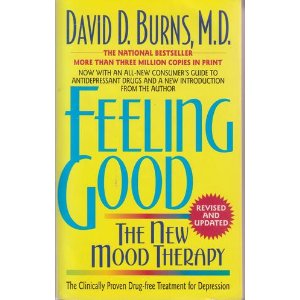
David Burns ‘Feeling Good, The New Mood Therapy’ – Book Review

David D. Burns - The New Mood Therapy

David D. Burns – The New Mood Therapy

If you are serious about overcoming depression The New Mood Therapy by Burns is definitely the book to buy. Reading it could be a new start in life for you, as it was for me.

The book was recommended to me way back in 1996 when I had depression. I never looked back. It actually changed my life! I don’t think any book can get higher praise than that!

Burns follows a Cognitive Therapy approach which is regarded as the best therapy for overcoming depression. The basic premise is that if you change your thinking, your mood will follow suit and change as well.

In ‘The New Mood Therapy’, Burns give many, easy to follow tools for overcoming faulty thinking patterns, which he calls ‘Cognitive Distortions’.

He writes in a very easy to read, humorous style. Normally one would associate dreariness with depression, but not so with this book! He has the ability to make the reader laugh when elaborating on some of the faulty thinking that rule our lives. Even if you’re not depressed it’s easy to identify with his examples. Knowledge gives power!

Now some 17 years later I still remember reading in bed and chuckling to myself about some of his illustrations. One in particular stays with me that made me laugh.

Seagull poops on Man’s Head!

A man was walking along the beach, and suddenly out of the blue, a seagull poops on his head with a perfect aim! The man’s response made me laugh even more.
‘Why is that ALWAYS happening to me?
No surprise he was feeling down in the dumps. I would also be if it happened to me ALL the time, EVERY time I set foot out the door! But the truth is that we often exaggerate with our thinking, which then pulls our mood down. Thinking realistically, a bad event seldom happens ‘ALWAYS’! The word ‘always’ is a warning that your thinking is tending towards overgeneralization - one on the list of cognitive distortions. ‘Sometimes’ is a better word and brings the thought back to reality!

I regard this book so highly, that I have bought extra copies over the years to give to friends who are depressed or anxious.

And the good news is that it is extremely reasonably priced – it costs the fraction of the price of one therapy session. Buying this book changed my life, it could change yours as well!

You can buy David D. Burns – The New Mood Therapy at Amazon.